
Jemy Finance Market Research Team At Jemy Trade Presents:
Article Date: August 28, 2025
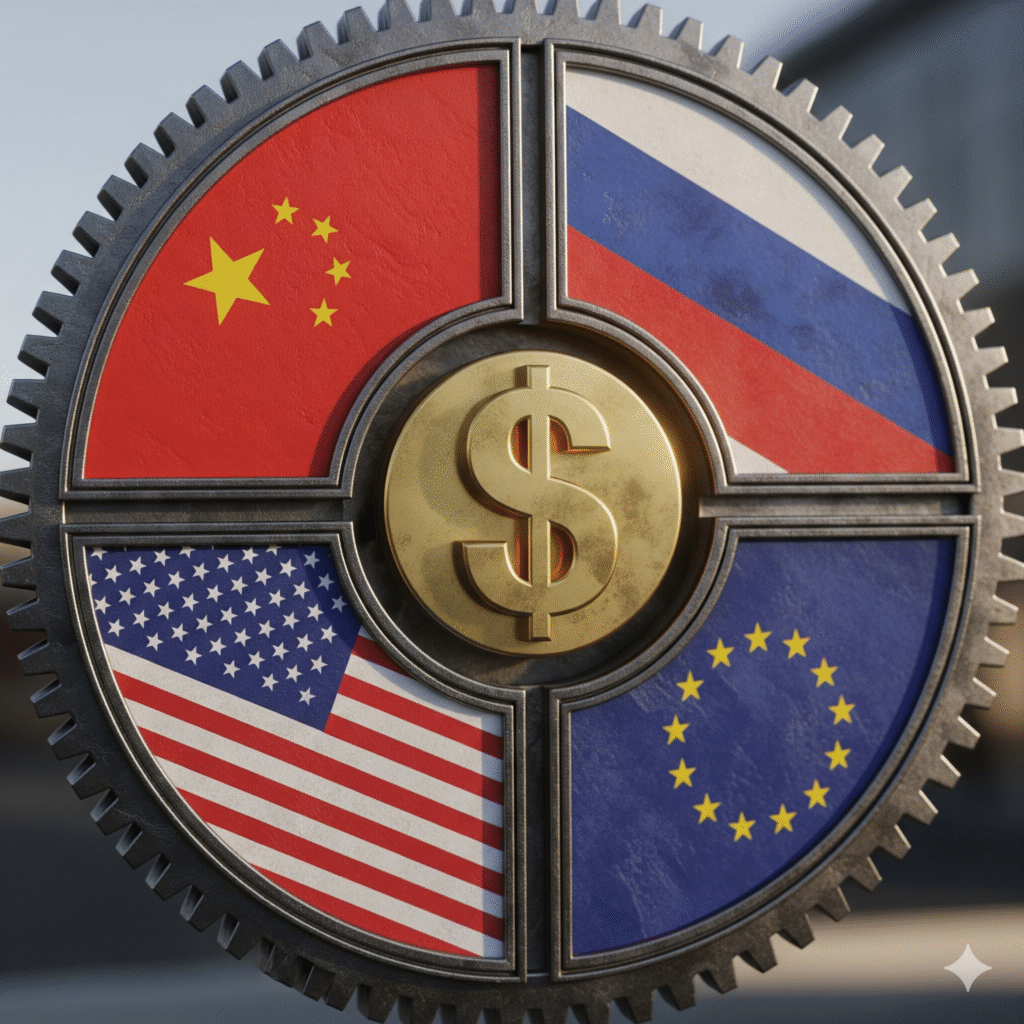
In the last decade, the economic relationship between the United States and China, the world’s two largest economies, has transformed from a complex partnership into a fierce competition, the most prominent manifestation of which has been the “Tariff War.” This war was not merely a traditional trade dispute; it was a profound reflection of a broader geopolitical and geoeconomic struggle aimed at reshaping global supply chains and determining future technological power. Understanding this war requires an analysis that goes beyond mere trade figures to delve into the political motives, economic impacts, and global strategic shifts.
The Motives Behind the Conflict
The motives behind the U.S. imposition of tariffs stem from several key points. First, it’s to address the massive trade deficit Washington has with Beijing, which is seen as a drain on the American economy. Second, there are accusations of unfair trade practices by China, such as intellectual property theft, government subsidies for Chinese companies, and forced technology transfer. Third, and most importantly, is the attempt to curb China’s rise as a technological superpower, especially in strategic sectors like semiconductors and artificial intelligence.
For its part, China sees these tariffs as part of an American strategy to contain its economic growth. Beijing has retaliated by imposing similar tariffs on American goods, from agricultural products to cars, with the goal of pressuring sectors of the U.S. economy, particularly in states that are political strongholds for the American leadership.
Mutual Economic Impacts
Although the tariffs were intended to protect domestic industries in both countries, their effects have been complex and multifaceted. For American companies, the increased cost of imports from China has raised production costs, forcing them to relocate some of their operations to other countries in Southeast Asia like Vietnam or Thailand, or even back to the United States. American consumers have indirectly borne some of these costs in the form of higher prices for imported products.
In China, the tariffs have led to a slowdown in export growth, especially in sectors that are heavily dependent on the American market. They have also affected the confidence of global companies in investing in China, prompting some to seek alternatives for their supply chains. However, Chinese trade has not completely collapsed, as Beijing has strengthened its trade relations with other countries, especially under the “Belt and Road Initiative,” to reduce its dependence on the American market.
Global Strategic Shifts
The impact of the tariff war has extended beyond the two countries involved, causing strategic shifts on a global scale. First, there is a growing awareness of the importance of diversifying supply chains, which has led to the emergence of “reshoring” or “nearshoring,” where companies move their production to geographically closer or more politically stable countries.
Second, tensions between countries have increased, as economic competition has become a political tool. The ability to impose economic sanctions and tariffs has become a key weapon in international relations.
Finally, this war has accelerated the technology race. As the U.S. attempts to deny China access to advanced semiconductors, Beijing has increased its massive investments in local research and development to achieve self-sufficiency.
Conclusion: Post-Tariff War
In the end, the tariff war did not bring a decisive victory for either side. While it failed to completely eliminate the American trade deficit, it also could not halt China’s technological progress. This war has proven that the interdependence between major economies is too deep, and any attempt to sever it completely will have significant costs for both parties.
The geoeconomic landscape after this war will be more complex and fragmented, as major powers will continue to compete, but this time not only through trade, but also through investment in technology, securing supply chains, and building new strategic alliances.